One barre shape, twelve chords
Most guitarists learn chord shapes as pictures: this grid is A, that grid is Am, this other one is Asus4. That's three things to remember. But they're not three shapes — they're one shape with one finger in three places, and knowing the scale degrees under your fingers is what turns the picture into something you can change on purpose.
1. Every chord is a recipe
A chord type is defined by which scale degrees it contains, counted from its own root. That's all. Here are the ones worth knowing first:
| Chord | Degrees | What changed |
|---|---|---|
| major | 1 3 5 | the baseline |
| minor | 1 ♭3 5 | 3 lowered a fret |
| sus2 | 1 2 5 | 3 replaced by 2 |
| sus4 | 1 4 5 | 3 replaced by 4 |
| 7 | 1 3 5 ♭7 | ♭7 added |
| maj7 | 1 3 5 7 | 7 added |
| m7 | 1 ♭3 5 ♭7 | both of the above |
| 6 | 1 3 5 6 | 6 added |
Two things fall out of that table immediately. The 1 and the 5 are in nearly everything — they're the furniture, and they barely affect the flavour. It's the 3 that decides major or minor, and the 7 that decides whether the chord sounds restless or settled. Change those and you've changed the chord.
Why "sus" means suspended. Sus2 and sus4 replace the 3 rather than sit alongside it. With no 3 there's nothing to make the chord major or minor — it's left hanging, wanting to resolve back. That ambiguity is the sound.
2. Label the shape you already know
Here's a plain A-shape barre chord at the 5th fret. Played at that fret it's a D major — but forget the letter for a moment and read the numbers instead:
Read it from the thick strings down: your root 1 is on the A string, then a 5, then the 1 again an octave up, then the 3, and a 5 on top. Recipe check: 1, 3 and 5 are all present. It's a major chord — of course it is.
Now note where each ingredient lives, because that's the part that pays off:
- The 3 is on the B string, two frets above the barre. It's alone — one note, and it's the one that decides major vs minor vs sus.
- The octave 1 is on the G string. It's a duplicate; you already have a root on the A string. That makes it the cheapest note in the chord to sacrifice — which is why it's where 7ths go.
- The 5 on the high e is the other spare. It's where a 6 goes.
This is the same neck geometry you already practise. Look at the G and B strings: same fret, 1 then 3. Anywhere else on the neck, one string thinner at the same fret gives you the next number in 7 3 6 2 5 1 4 — from a 1 that would be a 4. But G→B is the one string pair tuned a third instead of a fourth, so it lands a semitone short: a 3. Mind the gap — the same rule that trips you up in the trainer is what gives this chord shape its major third.
3. Move one finger, get a different chord
Everything below is the shape above with one note moved. The dashed ring shows where the finger came from; amber is where it went. Nothing else changes — same barre, same root, same fret.
The B string holds the 3 — so it holds the chord's mood
One finger, three destinations, three chords. And the distances aren't arbitrary — they're the major scale formula you already know. From 3 up to 4 is one of the scale's two half steps, so sus4 is a single fret. From 2 up to 3 is a whole step, so sus2 is two. You're not memorising fingerings; you're reading a ruler you already own.
The G string holds the spare octave — so it holds the 7ths
Same logic again: 7 up to 1 is the scale's other half step, so the maj7 is one fret below the octave and the ♭7 is one fret below that.
Stack them, or use the top string
Nothing here was memorised as a shape. Each one was derived: read the recipe, find the string holding the degree that needs to change, move it. That's the skill — and it's why this scales to chords you've never played before instead of stopping at the eight shown here.
Looking for a chord library instead? This page is about working chords out, which is a different job from looking one up. When you just need the shape for something you've only seen written down — an unfamiliar voicing, or a chord in a song you're learning — a dictionary is the faster tool. chordoracle.com is a good one. The two go together: look the shape up when you're in a hurry, and the degrees tell you why it's fingered that way.
4. Now do it on the E shape
The E shape is the other barre chord everyone learns. Same treatment: label it, find where the ingredients live, then move them. At the 5th fret this one is an A major.
The layout is different but the jobs are identical, just on different strings:
- The 3 moved to the G string, one fret above the barre.
- The spare octave 1 is on the D string, two frets above the barre — same role as the G string had in the A shape.
The G string sets the mood here
And the D-string octave holds the 7ths
The one that doesn't work — and why that's useful
There's no E-shape sus2 above. That's not an oversight. In this shape the 3 sits one fret above the barre, and the 2 is a whole step below the 3 — which puts it one fret behind the barre, where no finger can go.
This is worth dwelling on, because it's the method proving itself. Guitarists know from experience that sus2 chords tend to get played out of the A shape. The degrees tell you why, in one sentence, without anyone having to memorise the exception. When your mental model starts predicting things you previously just had to accept, it's a good model.
5. Why none of this needs a key
Read back over everything above and notice what's missing: note names. Not one instruction said "put your finger on an F♯". Every move was described in degrees — and degrees are identical in all twelve keys.
So the A shape at the 5th fret is D, at the 3rd fret it's C, at the 8th it's F. The finger that turns it into a sus4 is the same finger, the same direction, the same one fret, every single time. You learned one thing and got twelve keys. That's the same trade the trainer is built around, applied to chords instead of single notes.
6. How to practise this
- Take a barre chord you already play and, without moving your hand, name the degree under each finger. Slowly at first. This is the whole exercise.
- Pick a target — "make it a sus4" — and work out which string has to move before you move it. Guessing and checking by ear teaches you much less.
- Play the pair back to back: major, sus4, major. Hear what that one fret did.
- Move the whole thing to a different fret and do it again. If it still works without re-thinking, you've learned the pattern rather than a position.
The prerequisite for all of it is being able to see degrees on the neck at speed — which is precisely what Fretboardwalk drills. Get comfortable finding a 3 or a ♭7 without counting, and this chapter stops being arithmetic and starts being something your hands just do.
Quick recap
- A chord is a recipe of scale degrees: major = 1 3 5, minor = 1 ♭3 5, sus4 = 1 4 5, and so on.
- A chord shape is just where those degrees happen to fall. Label yours once and you can alter it deliberately.
- A shape: the 3 is on the B string (mood), the spare octave is on the G string (7ths), the top 5 becomes a 6.
- E shape: the 3 is on the G string, the spare octave is on the D string. Same jobs, different addresses.
- The distances come from the major scale formula — 3→4 and 7→1 are the half steps, everything else is two frets.
- Sus2 is awkward in the E shape because the 2 falls behind the barre. The model predicts the exception instead of you memorising it.
- None of it names a note, so all of it transposes for free.
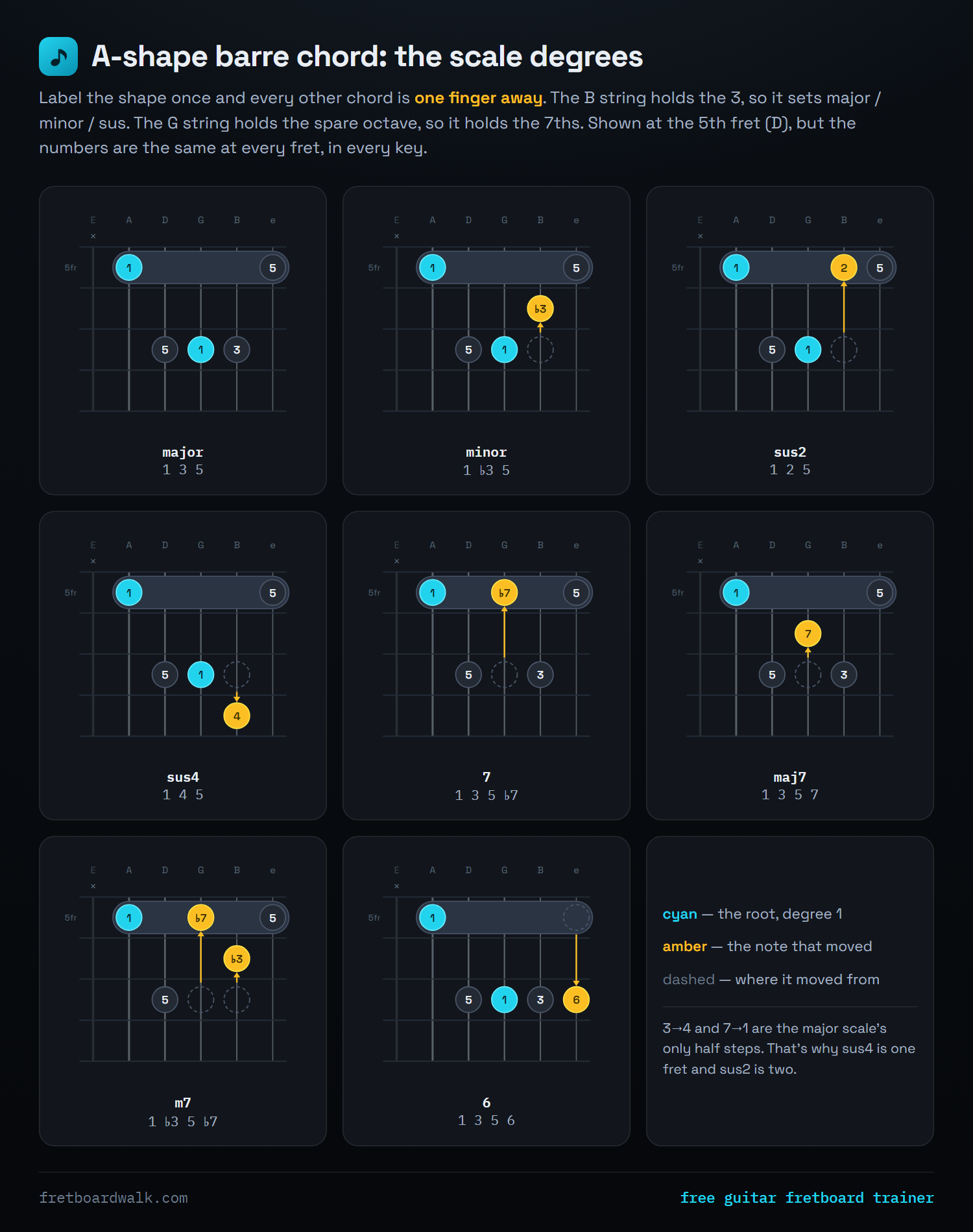
The whole thing on one chart
Every alteration on this page in a single image — worth saving to your phone and pulling up when you're actually holding the guitar.
FAQ
How do scale degrees help you build chords?
A chord is a recipe of degrees — major is 1 3 5, a dominant 7 is 1 3 5 ♭7. Once you know which string plays which degree, changing the chord means moving the finger holding the degree the recipe wants changed. No new shape required.
Which finger plays the 3rd in an A-shape barre chord?
The B string, two frets above the barre. Lower it one fret for minor, two for sus2, raise it one for sus4. Nothing else in the shape moves.
How do I turn a barre chord into a 7th chord?
Find the spare octave — the second 1 in the shape — and lower it. Two frets gives you the ♭7 (a dominant 7); one fret gives you the 7 (a maj7). In the A shape that note is on the G string; in the E shape it's on the D string.
What's the difference between sus2 and sus4?
Both replace the 3, which is why neither sounds major or minor. Sus2 puts the 2 there (a whole step below the 3), sus4 puts the 4 there (a half step above it) — two frets down, or one fret up.
Why is sus2 awkward on an E-shape barre chord?
Because the 3 sits only one fret above the barre, so the 2 a whole step below it lands behind the barre, out of reach. That's why sus2 chords get played out of the A shape — the degrees explain the fingering, not the other way round.
Do these moves work in every key?
Yes — nothing here mentions a note name. Slide the A shape to the 5th fret and it's D, to the 8th and it's F; the finger that makes it a sus4 is the same either way.
Do I need to know the notes first?
Not for this. You do need to see degrees quickly, which is a different skill — the trainer is built for exactly that. If the plain note names are still shaky, start there.
Learn to see the degrees
All of this rests on one ability: finding a degree on the neck without counting. That's what the trainer drills.
Open the trainer →