One shape, two keys: the major/minor degree map
Here's a fact that saves you half your practice: a major scale and its relative minor are the exact same notes and the exact same shape on the neck. So instead of learning them twice, you can learn one map that carries both sets of scale degrees at once — and a single circle, 7 3 6 2 5 1 4, ties the whole thing together.
1. Two numbers on every note
Every note in the scale has a job in each key. Take the note C: in C major it's the 1 (home). But the same scale is also A minor — and in A minor, C is the ♭3. Neither is "more correct"; the note simply has two names depending on which tonic you call home. Here's the full translation:
| Major degree | 1 | 2 | 3 | 4 | 5 | 6 | 7 |
|---|---|---|---|---|---|---|---|
| Minor degree | ♭3 | 4 | 5 | ♭6 | ♭7 | 1 | 2 |
| Note (C / Am) | C | D | E | F | G | A | B |
The two tonics are the highlights: the major 1 (C) in yellow, and the minor 1 (A) in pink — which is the major 6. New to this idea? The relative minor is covered on the minor-scale page, and the numbers themselves on scale degrees explained.
2. The map
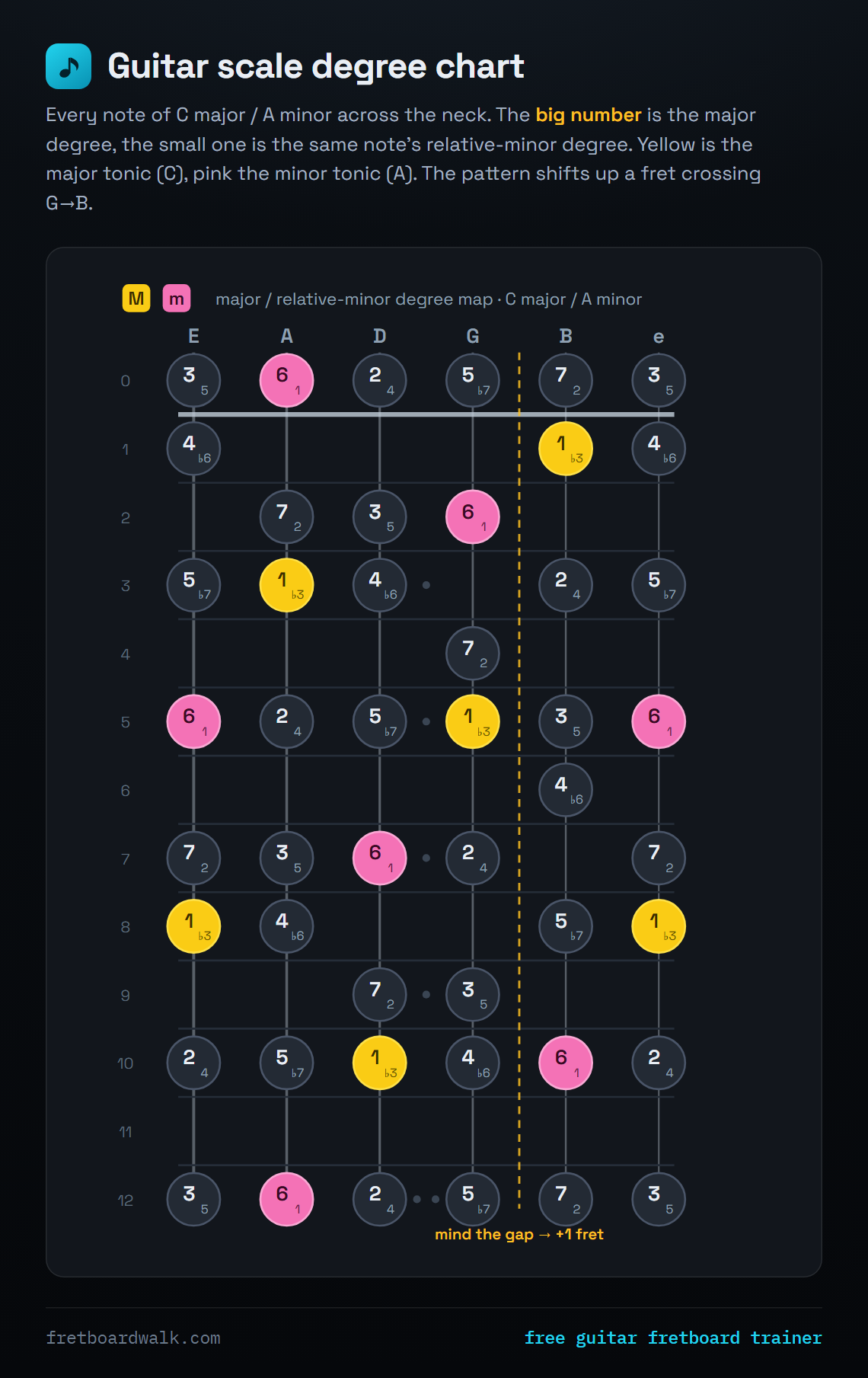
Here's C major / A minor across the whole neck, every note carrying both degrees. Look for the pattern, not the individual notes — the same little shapes repeat.
3. Two things to memorise
Everything below comes down to two patterns, and they divide neatly: one tells you how to move along a string, the other how to move across them. Between them they get you from any degree to any other, anywhere on the neck.
① The major scale formula — moving along one string. The gaps between consecutive degrees, in frets: W W H W W W H. A whole step (W) is two frets, a half step (H) is one. Only two of the seven gaps are half steps — 3→4 and 7→1 — and knowing which two is the whole trick. Everything else is two frets. Full walkthrough here.
② The sequence 7 3 6 2 5 1 4 — moving across the strings. At the same fret, each string over is the next number along. That's what tells you what's sitting beside your finger without counting anything up.
Pick a degree, reach across at the same fret to get near, then slide a fret or two to land. That's the whole method — and it's exactly what the trainer's hint walks you through, one move at a time.
4. The sequence: why 7 3 6 2 5 1 4
Why that odd-looking sequence? It's the circle of fourths — every step is up a perfect fourth (7→3, 3→6, 6→2, and so on). And it maps straight onto the guitar, because standard tuning is (mostly) a stack of fourths: at the same fret, the next thinner string (toward the high E) is a fourth higher — which is exactly the next number in this circle.
5. The real payoff: instant neighbours
This is the whole reason to memorise the sequence. It tells you what's on the strings right next to you at the same fret — so you never have to work a note out in isolation. Say you're on a 6: the next thicker string (toward the low E) is a 3, and the next thinner string (toward the high e) is a 2. Why? Because 3 and 2 are exactly the numbers on either side of 6 in the circle: 7 3 · 6 · 2 5 1 4.
So the rule is dead simple: toward the thick strings, step back one place in 7 3 6 2 5 1 4; toward the thin strings, step forward. Once that's automatic you can move sideways across the neck as fluently as up and down a single string.
6. The sequence's two edge cases
The sequence is a loop, and one of its seven joins isn't a perfect fourth: the one from 4 round to 7. At that join the same-fret trick stops working — the note you land on isn't in the key at all. It falls in the crack between two scale degrees.
This is not something to work out at the fretboard. There are exactly two positions, and they are the same join seen from its two sides. Learn them the way you learned the open strings:
Everywhere else on the neck the sequence holds exactly. Here you are a fret out, and going one further lands you right. That is the whole of it: two positions, memorised, done.
If you like knowing why: the odd join isn't a quirk, it's forced. Seven steps have to bring you back to where you started, so they must add up to whole octaves — and seven perfect fourths come to 35 semitones, one short of the 36 in three octaves. Exactly one join has to stretch, and there's nowhere else to put it. You never need this to play; it just means there's nothing to be annoyed about.
7. Mind the gap (the B string)
That catch was in the sequence. This one is in the tuning, and it's the thing every guitarist has to internalise. Standard tuning is fourths everywhere except one place: the jump from the G string to the B string is a major third, not a fourth. That single "gap" throws the pattern off by a semitone.
On the map above it's the dashed line between the G and B strings. It's the second place the neighbour trick from Step 5 needs care: crossing G→B at the same fret doesn't give the next number in the sequence — that degree sits one fret higher. Note the difference from the edge cases above: the sequence isn't broken here, only displaced. Keep following it and allow for the shift. Forget it and your shapes suddenly land on wrong notes — hence the reminder scribbled on the original: mind the gap.
Two odd joins, then, and they behave alike: the tuning has one string pair that isn't a fourth (G→B); the sequence has one join that isn't a fourth (4→7). Hit both at once — a 4 on the G string — and they stack, so that move needs two frets rather than one.
The gap isn't only a hazard, either. It's the reason an A-shape barre chord has a 1 and a 3 sitting at the same fret on the G and B strings — anywhere else that pair would be a fourth apart. Building chords from degrees picks that up.
8. How to actually use it
This map is a way of seeing, but seeing isn't knowing — you still have to make it automatic. Pick which tonic is home (yellow for a major key, pink for its relative minor), then drill finding the degrees on a real neck until you don't have to count. That's what Fretboardwalk is for: it quizzes you on exactly these positions, in any key, and plays the real note back. If the raw note names aren't solid yet, start with memorising the fretboard first.
Quick recap
- A major scale and its relative minor (C major / A minor) are the same notes and shapes.
- Every note has a major degree (big) and a minor degree (small ♭), depending on which tonic is home.
- Two patterns to memorise. The major scale formula (W W H W W W H) moves you along one string; the sequence moves you across them. Only 3→4 and 7→1 are half steps — everything else is two frets.
- 7 3 6 2 5 1 4 is the circle of fourths — the order degrees stack across the strings.
- It gives you same-fret neighbours: toward the thick strings step back, toward the thin strings step forward. (On a 6: thicker = 3, thinner = 2.)
- The G→B string is a third, not a fourth, so the pattern shifts up one fret there. Mind the gap.
- The sequence has one odd join too: 4 round to 7. Two positions to memorise — a string thinner from a 4 lands between the 6 and 7; a string thicker from a 7 lands between the 4 and 5. Go one fret further.
The chart, to keep
The whole map in one image — save it, print it, stick it on the wall behind the amp.
FAQ
Why does every note have two scale-degree numbers?
Because the same notes are two keys at once. In C major, C is the 1; that identical scale is also A minor, where C is the ♭3. Big number = major degree, small = relative-minor degree.
What is the relative minor?
The minor key that shares a major key's exact notes, built on its 6th degree. A minor is the relative minor of C major — same notes and shapes, centered on A instead of C.
What is the 7 3 6 2 5 1 4 sequence?
The circle of fourths — each step is up a perfect fourth. Because guitar tuning is mostly fourths, the degrees stack in this order as you move across the strings.
What are the two things you need to memorise?
The major scale formula and the sequence — one for each direction you can move. The formula (W W H W W W H) tells you how far to slide along a single string: only 3→4 and 7→1 are half steps, everything else is two frets. The sequence 7 3 6 2 5 1 4 tells you what sits on the neighbouring strings at the same fret. Reach across, then slide.
Where does the 7 3 6 2 5 1 4 sequence stop working?
At one join only: 4 round to 7. There the same-fret note isn't in the key. Two positions to memorise and you're covered — one string thinner from a 4 lands between the 6 and the 7, and one string thicker from a 7 lands between the 4 and the 5. Go one fret further and you're on the real degree. (It's forced, not arbitrary: seven perfect fourths come to 35 semitones and three octaves are 36, so one join has to stretch.)
What does "mind the gap" mean?
Tuning is all fourths except G→B, which is a major third. That gap shifts the degree pattern up one fret as you cross to the B string — the most common fretboard trip-up.
Is the major shape the same as its relative minor shape?
Identical — same shape, same notes. Only which note feels like home changes, so one pattern gives you two keys.
Make the map automatic
Reading it is step one. Being able to find any degree without counting is the goal.
Open the trainer →